Atelier, Toronto, ON
Agentic AI workflows from concept to production
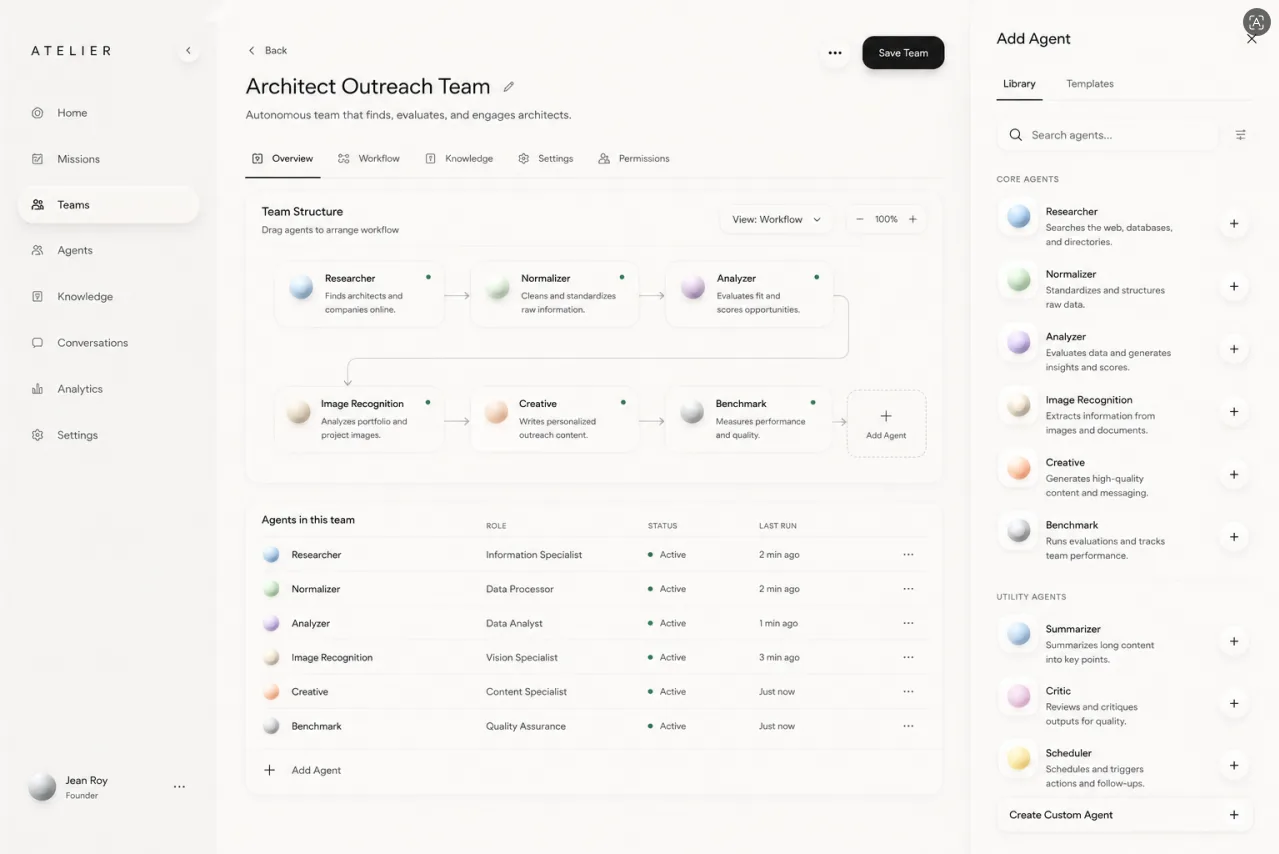
Agentic AI workflows taken from concept to production, including the parts that decide what happens when a run does not go as planned.
Most businesses asking about AI are not describing an AI problem. They are describing repetitive work: quoting, triaging enquiries, summarising documents, moving information between systems, answering the same question in different words forty times a week.
Some of that is worth automating and some of it is not. The test we use is simple. How often does the task happen, how long does it take, and what does it cost when it is done wrong. If the answers are rarely, briefly, and not much, automation is a distraction.
When the answers point the other way, this is our Applied AI pillar: AI teams, AI engines, automation and AI-assisted workflows.
The work that suits it well tends to involve messy input and a clear output. Turning a long email thread into a structured record. Sorting incoming requests so the urgent ones surface first. Drafting a first version of something a person then edits. Extracting fields from documents that arrive in twelve different formats.
The work that suits it badly involves precision, accountability or arithmetic. Anything where being confidently wrong is worse than being slow. For those steps we use ordinary deterministic code, and we keep a person in the loop where a mistake would reach a customer.
A lot of what gets asked for as AI is better served by plain automation: a scheduled job, a webhook, a rule. That is cheaper, more predictable and easier to debug, and we will recommend it when it fits.
AI features are built as part of a system rather than bolted on beside one. Inputs are validated, outputs are checked against an expected shape before anything is stored, failures fall back to a defined behaviour instead of an error, and every run is logged so you can see what happened and what it cost.
We keep model choices replaceable. This field moves quickly, and code that assumes one specific provider forever is code you will be rewriting. Cost controls and usage limits are set from day one, because the failure mode of an unmonitored AI feature is a bill rather than an outage.
Where AI assists a human workflow we design the handoff carefully: what the person sees, what they can override, and what gets recorded about the decision.
A typical engagement starts small: one workflow, one measurable before and after. We map how the task runs today, including the exceptions people handle without thinking about them, then automate the path that covers most of the volume and route the rest to a person.
From there it either earns a second phase or it does not. We would rather prove one automation is saving real time than deliver five that everybody quietly works around.
Same five steps. The opportunity step carries more weight here than anywhere else we work, because it is where we decide whether AI belongs in the project at all.
01
We understand the real problem.
02
We identify what's possible and valuable.
03
We define the right solution and roadmap.
04
We design and build with purpose.
05
We measure what matters and keep improving.
One project, and only one, where this was genuinely the work.
Atelier, Toronto, ON
Agentic AI workflows taken from concept to production, including the parts that decide what happens when a run does not go as planned.
Describe the task, how often it happens, and what it costs when it goes wrong. We will tell you honestly whether automation is worth building.