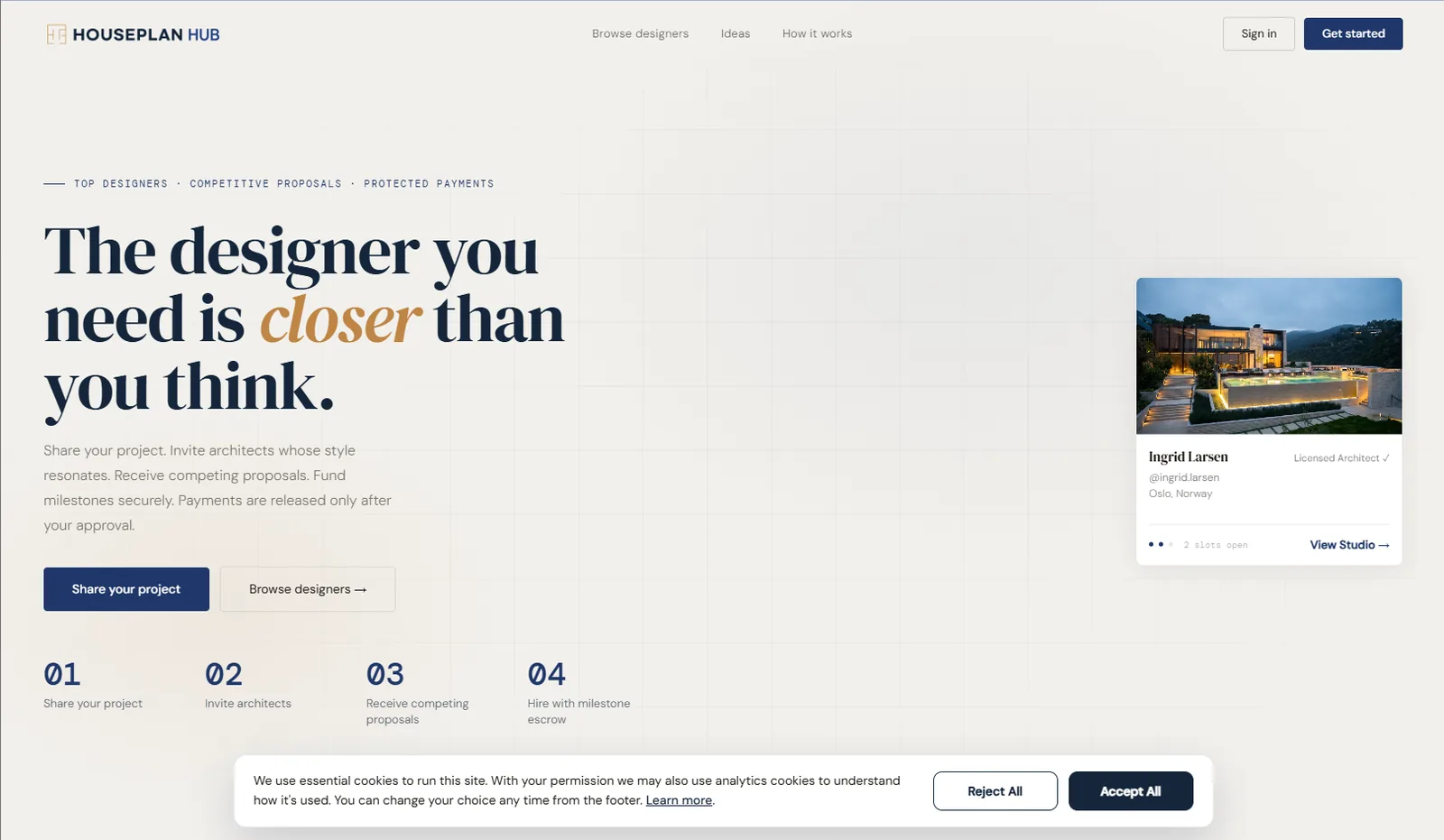
HouseplanHub, Montreal, QC
Homeowners matched with freelance architects
A matching platform with two sides to serve, accounts on both, and rules about who can see which project at which stage.
There is a point where a business stops needing a better website and starts needing software. Usually you can name the moment. Two people are keeping the same spreadsheet in sync by hand. Client updates go out one email at a time. Somebody rekeys the same order into three systems and occasionally gets it wrong.
None of that is a design problem. It is a systems problem, and it does not get solved by adding pages. It gets solved by building the thing that holds the data, enforces the rules, and gives each person exactly the view they need.
That is what this service is. Custom development on the web, in our Business Systems pillar: cloud web applications, client portals, internal tools and workflow systems.
Cloud web applications, where the product is the software itself and the browser is the delivery mechanism. Client portals, where your customers see their own projects, documents, invoices or status without emailing to ask. Internal tools, which are usually the highest return work we do because they replace hours of manual handling every week. And workflow systems that move a job through its stages with the right notifications, permissions and records at each step.
Most of these projects also involve connecting to something that already exists. An accounting package, a CRM, a scheduling tool, a supplier feed. We build around the tools you already pay for wherever that is sensible, rather than proposing a rebuild of everything because it would be tidier for us.
We work in typed JavaScript on the server and the browser, with a relational database underneath and access rules enforced at the database rather than only in the interface. That last point matters more than it sounds: if permission logic only lives in the front end, anyone who can open developer tools can go around it. Rules belong where the data is.
Validation runs on the server as well as in the form. The client version exists to give people fast feedback; the server version is the one that decides. Anything a user could tamper with, including totals, tiers and role assignments, is recomputed server side before it is stored.
We ship in working increments rather than disappearing for three months. You get something usable early, then we widen it. That is partly about risk and mostly about accuracy, because people describe what they need very differently once they are clicking on it.
Every project gets a real data model before it gets screens. What the entities are, how they relate, what has to be unique, what happens when something is deleted. Getting that wrong is the single most expensive mistake in this kind of work, because everything built afterwards inherits it.
Authentication, roles and audit trails are designed in from the start. Who can see what, who can change what, and what record exists afterwards. Roles are stored properly in their own table rather than as a flag on a user profile, which is the difference between a permission system and a suggestion.
We also plan for failure states, because they happen. What the system does when an external service is down, when a payment succeeds but the follow up email does not send, when the same webhook arrives twice. Handling those cases is unglamorous and it is most of what separates software that holds up from software that needs a person watching it.
You own the code and the infrastructure accounts. We document how the system is put together, how to deploy it, and where the parts that will need attention are.
Custom software is not finished at launch, and we would rather say so up front than pretend otherwise. Requirements change, usage patterns surprise everyone, and small improvements after three months of real use are usually worth more than another feature at launch. Care plans cover that if you want them, and you are free to take the work elsewhere if you do not.
If what you need is a public facing site rather than a system behind a login, custom web design is the right page. Plenty of projects need both, and in that case we scope them as one piece of work.
Development projects run through the same five steps as our design work. The build phase is longer and the measure phase is where most of the real learning happens.
01
We understand the real problem.
02
We identify what's possible and valuable.
03
We define the right solution and roadmap.
04
We design and build with purpose.
05
We measure what matters and keep improving.
Two projects that were software behind a browser, not websites.
HouseplanHub, Montreal, QC
A matching platform with two sides to serve, accounts on both, and rules about who can see which project at which stage.
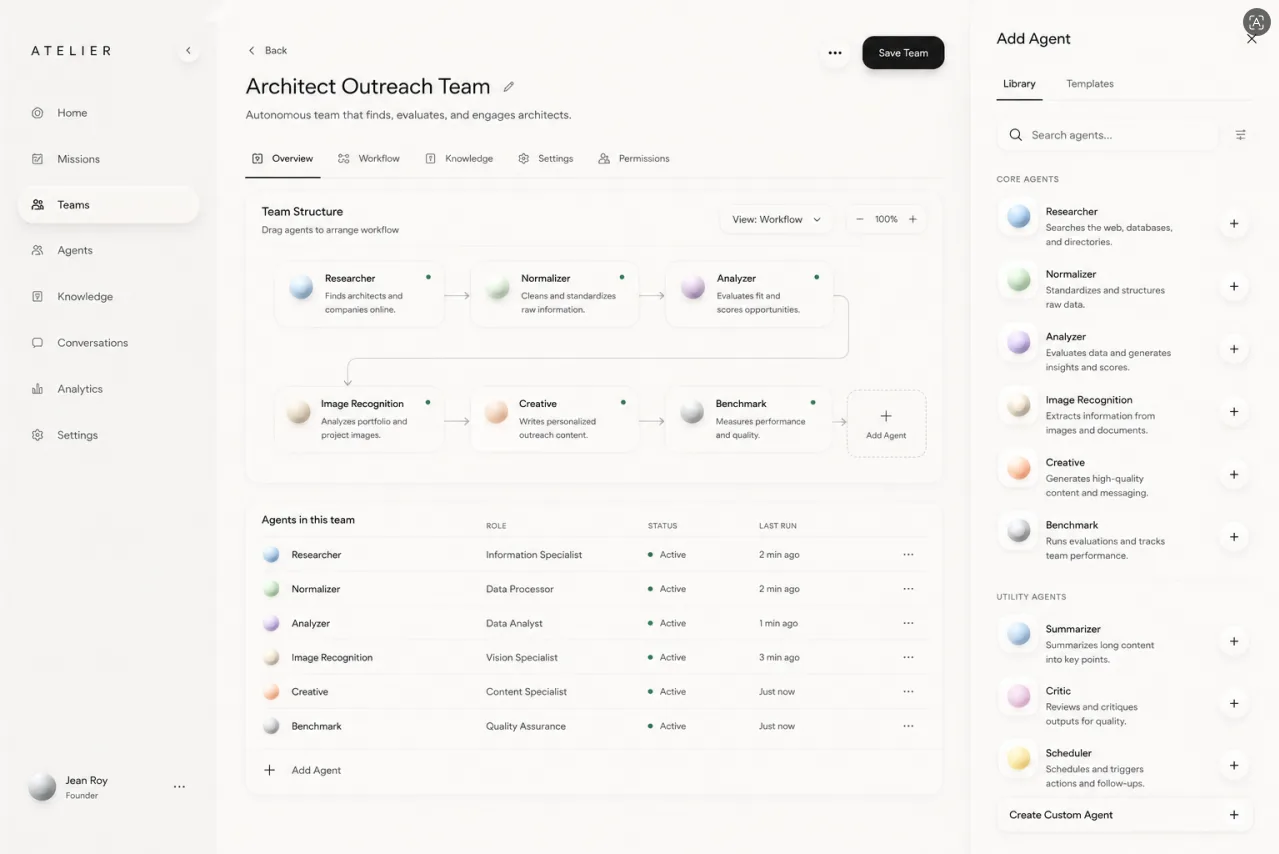
Atelier, Toronto, ON
An application for designing and running agentic AI workflows, taken from concept through to something running in production.
Describe the process that is costing you time and what it currently runs on. We will tell you whether it needs custom software or something simpler.